An Engineer’s Guide to Better AI Skills: Implementing a Testing Process to Optimize Agent…

Summary
Stop Guessing, Start Testing: Pinterest's Guide to Optimizing AI Agent Skills
Boost your AI agent's reliability from 60% to near-perfection with a data-driven testing framework.
Learn how Pinterest Engineering quantifies and improves the reliability of custom AI skills. This guide explores building a test harness, benchmarking Codex and Claude, and implementing proven optimization techniques for complex repositories.
- 01Automating AI performance measurement using a Bash-based test harness
- 02Defining Positive and Negative test cases to detect false positives in skill usage
- 03Strategic use of Frontmatter and AGENTS.md for context-aware skill loading
- 04Comparative analysis of optimization impact on OpenAI Codex vs. Anthropic Claude
- 05Practical evidence that explicit intent and verbose instructions are the ultimate reliability drivers
RECOMMENDATION
Engineering teams using AI agents should prioritize building a quantitative test harness over qualitative feedback to ensure workflow reliability.
The Problem
AI agents showed unreliability in invoking specific domain-specific skills, such as Pinterest's iOS architecture rules, hindering the automation of engineering workflows.
The Solution
The team implemented a Bash-based test harness to track skill invocation rates across positive and negative cases and applied optimizations like frontmatter descriptions and AGENTS.md skill tables.
The Result
Baseline accuracy (73% for Codex, 62% for Claude) was significantly improved through contextual frontmatter descriptions, achieving consistent results when intent was clear.
Trade-off
Optimizing AGENTS.md increases token usage in the context window, and AI-driven self-improvement of prompts unexpectedly led to lower invocation rates in some cases.
Key Concepts
 More from Pinterest
View all posts from Pinterest핀터레스트 홈 피드를 위한 조건부 학습 검색(CLR) 확장하기
Recommendation SystemsLearned RetrievalTransformer3일 전피너의 성장: 핀터레스트의 주간 활성 사용자 증가를 이끄는 유스케이스 표현 개선 사례
Recommendation SystemsClusteringEmbeddings1개월 전대규모 인프라 보안 확보: 핀터레스트의 리소스 프로비저너 파이프라인(RPP) 도입기
TerraformAWSGitHub Actions1개월 전핀터레스트 파운데이션 모델을 위한 선형에 가까운 학습 확장성 달성
Distributed TrainingPyTorchNCCL2개월 전핀터레스트의 차세대 DB 인제스션 프레임워크 내 자동화된 스키마 진화
CDCApache IcebergFlink2개월 전
Related reads#AIAgents
Explore #AIAgents
분석가가 직접 만든 마케팅 자동화 시스템 — 오디언스 빌더 제작기
AI 시대의 개발 능력은 검증력으로 결정된다, Flava API Gateway 개발 중 배운 빠른 검증과 로컬 환경 구성 전략
사내 AI 에이전트 개선기
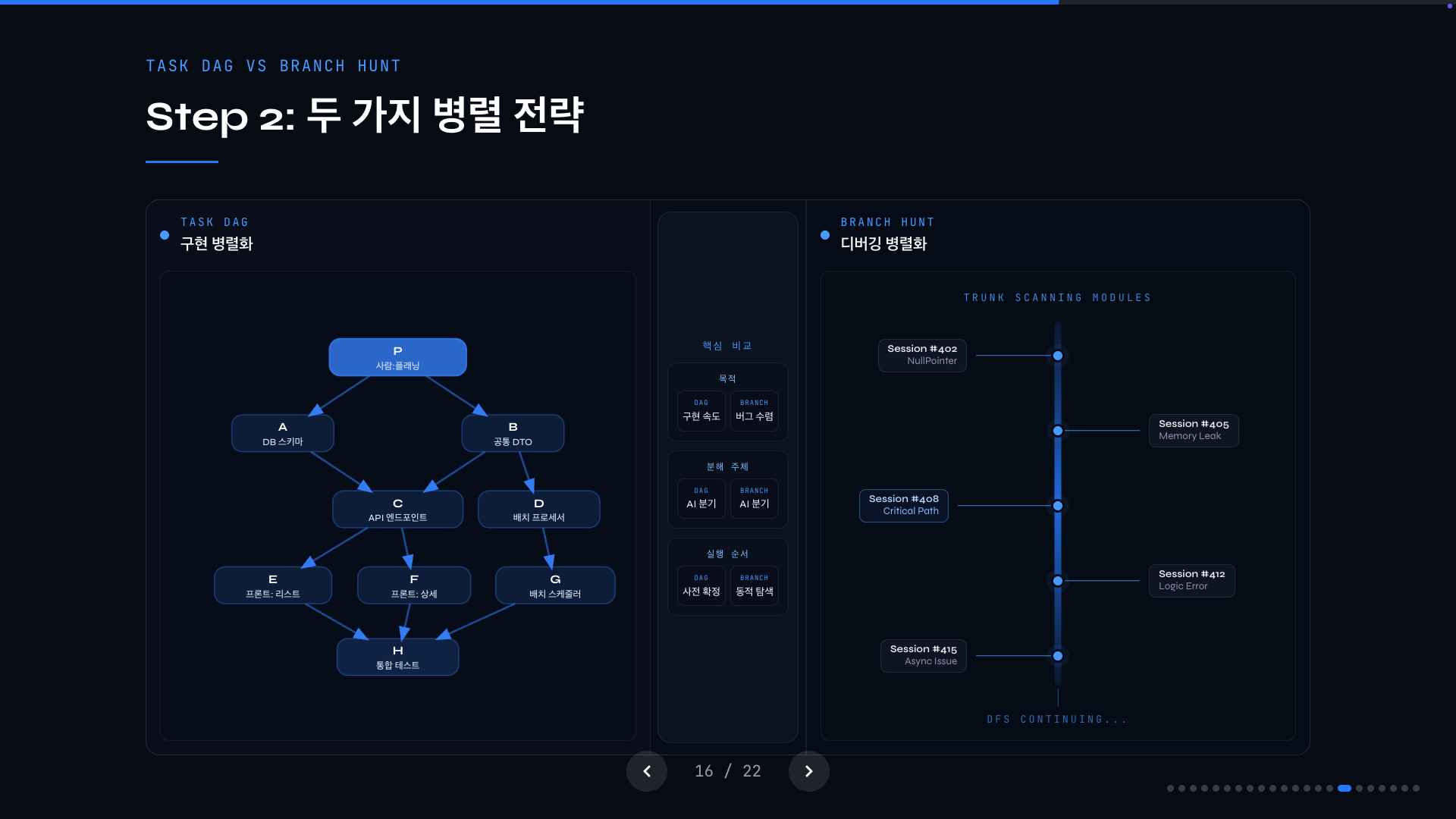
AI 에이전트 15개를 동시에 굴리는 법 — AI 병렬 오케스트레이션 실전 운용기